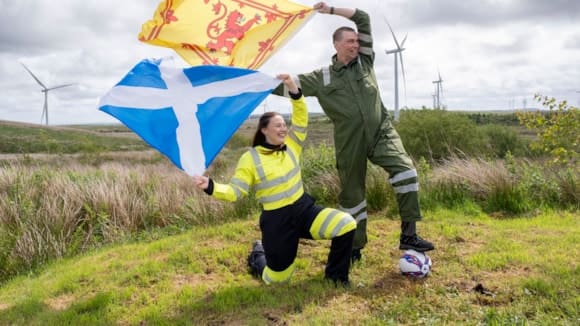
As Scotland prepares for its first men’s World Cup appearance since 1998, ScottishPower and SSE are gearing up to help power what is expected to be one of the biggest electricity surge events in Scotland for the early hours of a Sunday morning.
The match against Haiti, taking place in Boston at 02:00BST on Sunday 14 June, is expected to draw viewers in homes, pubs and organised fan zones across the country. Engineers anticipate a 5–10% increase in overnight electricity demand – the equivalent of around 284,000 additional homes coming online - during what is typically one of the quietest periods for the network.
The last time Scotland’s men’s team appeared at the World Cup in 1998, the country was powered by fossil fuels and nuclear generation. Today, its electricity is predominantly powered by renewables – from iconic assets like ScottishPower’s Whitelee Windfarm and SSE’s hydroelectric schemes.
The way the network operates has also fundamentally changed over the last three decades. Growing use of electric vehicles, heat pumps and more efficient homes is reshaping overnight demand, as overall electricity use continues to increase and is expected to double by 2050.
The UK’s electricity grid is one of the most reliable in the world, with 99.9% reliability. It was last transformed in the 1950s when people had an average of six electrical devices in the home – today that figure is 13.
Together, ScottishPower and SSE are investing over £53 billion (Scottish Power £28bn, SSE £25bn) in the next five years to strengthen and expand Scotland’s electricity infrastructure – supporting renewable generation and the network upgrades needed to meet rising demand and maintain a reliable, resilient system.
Keith Anderson, ScottishPower CEO, said: “We’re gearing up for a huge moment as millions of people, from across the generations, come together in the early hours of the morning for the national men’s team’s return to the World Cup for the first time in almost three decades.
“While supporters focus on the football, the homes, businesses, pubs and fan zones will be connected to an electricity grid that’s powered by renewable generation and monitored 24/7 by our networks teams to keep power flowing.”
Paul Murray, Head of SSE Distribution Control, said: “We’re proud to be helping power Scotland’s supporters as they tune in to cheer on the team at a World Cup for the first time in a generation. Many of the colleagues working to keep the power flowing hadn’t been born the last time Scotland went to the World Cup, which underlines just how significant a moment this is.
“Scotland’s electricity system has never been more central to everyday life, and moments like this highlight the importance of a modern, resilient network that can respond to changes in demand. Behind the scenes, our teams are monitoring and managing the system to ensure a reliable supply to homes and businesses.
“Our ongoing investment in Scotland’s energy infrastructure is creating a new legacy for Scotland – and we hope the team can do the same.”
Comparing their 1998 and 2026 World Cup experiences at Whitelee Windfarm were ScottishPower’s Tom Connell (57) and SSE’s Chloë Crawford (23).
Tom began his energy career in 1985 on a youth training scheme as a chemist, officially joining the South of Scotland Electricity Board in 1986. Starting out at Cockenzie Coal power station in East Lothian in the general services department, he worked his way through the kitchens and as the station postman before finding his way into the station control in 1988, when he reached 19.
For the 1998 World Cup, aged 27, he worked at Cockenzie, but now works as a Senior Control Room Operator at Whitelee Windfarm on the outskirts of Glasgow – the biggest onshore windfarm in the UK.
He said: “After Cockenzie, I moved to Longannet Power Station in Fife in 2012 and onto Whitelee in 2016, so I’ve certainly followed the energy transition from coal to renewables.
“But if you’d have told me as a young 27 year-old in a windowless control room in the basement of Cockenzie power station that almost three decades on I’d be sat in the control in room at the UK’s largest onshore wind farm, powering the country with renewable energy and Scotland still hadn’t been to another World Cup – I wouldn’t have believed you.
“Mind you it’s probably a bigger shock we haven’t been to the World Cup in all that time, but we are now!”
Tom lives in Stewarton, Ayrshire, but used to live ten minutes’ walk from Cockenzie in Port Seton, East Lothian. He is due to retire in August this year after 40 years’ service.
He said: “If I remember right, I was working when the Brazil game was on but there were no televisions in the control room or mobile phones in those days.
“We’d have been doing plant checks and keeping an eye on things ahead of full-time but would’ve had it on the wireless and be able to check in on the score during breaks. I remember it was a shock when I heard we were drawing one each.”
Chloë, from Edinburgh, is a Trainee Project Manager at SSEN Transmission and is currently in the second and final year of her apprenticeship. Since joining the company, she has been gaining hands-on experience supporting projects that help strengthen and modernise Scotland’s electricity network.
She is part of a new generation helping to deliver the infrastructure that will support communities across the country for years to come.
She said: “I wasn’t even born the last time Scotland played at a World Cup, so it’s pretty amazing to see the country get behind the team and know I’m experiencing this for the first time. It also really brings home just how much has changed since 1998, not just in football, but in our energy system too. Back then, electricity was mainly generated from fossil fuels, whereas today far more comes from renewable sources so the whole system is much more dynamic.
“I love being part of that transition to cleaner energy, it’s exciting to know that, in my own way, I’m helping support a system that’s more sustainable, resilient and ready for moments when the whole country switches on at once.”
One partner. No competitors. Full visibility across the region.